Hidden Bird Species Discovered in Japan After DNA and Song Reveal a Secret
The Tokara Leaf Warbler, Phylloscopus tokaraensis, shows how DNA, breeding-season song and island geography can reveal a distinct bird that looks almost identical to a familiar relative.
Leo Sato ·

The newly recognized Tokara Leaf Warbler is a reminder that a bird can be hidden in plain sight. On the Tokara Islands of the northern Ryukyus, birds long treated as part of Ijima’s Leaf Warbler looked so similar that plumage alone was not enough to settle the question. Genetic evidence, breeding-season song and island geography now point to a distinct species, Phylloscopus tokaraensis, with a singing male documented on Nakanoshima in June 2017 becoming one of the public images of the discovery.

The mechanism is cryptic speciation. Small insect-eating leaf warblers often share a greenish, lightweight body plan that works well in foliage, so visual differences can remain subtle even after populations stop freely mixing. Song matters because it helps birds recognize mates and defend territories. DNA matters because it records ancestry that the eye may miss. When genetics, voice and breeding distribution point in the same direction, taxonomists have stronger evidence than a field mark alone.
The geography makes the case especially interesting. The Tokara Islands form part of a chain between Kyushu and Amami-Oshima, a region where currents, storms, island distances and habitat patches can isolate small populations. Ijima’s Leaf Warbler is associated with other islands in the Izu and Ryukyu systems, while the Tokara birds appear to carry their own evolutionary history. Naming that history does not create the bird; it gives observers a way to see it accurately.
The “stunning secret” is therefore not a magic DNA trick. It is the patient convergence of museum specimens, field recordings, breeding observations and sequence data. A hidden species becomes visible when many small lines of evidence agree. That is why the finding has been described as Japan’s first new bird species recognition in more than four decades: the country’s birds are watched closely, so an overlooked resident lineage is scientifically meaningful.
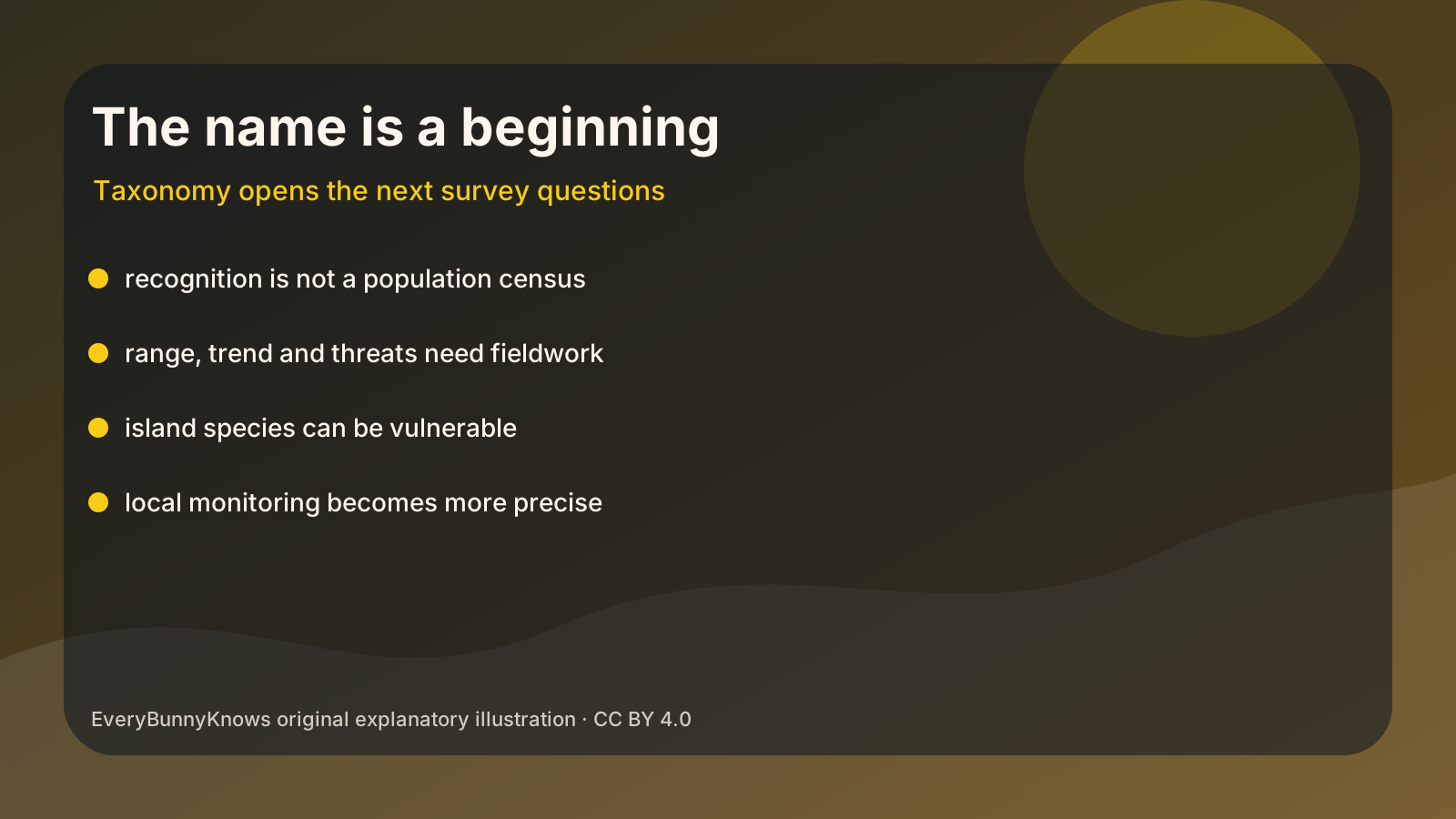
The limits should be kept clear. A species description or recognition does not by itself tell us how many Tokara Leaf Warblers exist, whether the population is increasing or what threats matter most. Island birds can be vulnerable to habitat change, severe weather, invasive predators and small-range accidents, but those risks need local evidence rather than dramatic assumptions. Close similarity to Ijima’s Leaf Warbler also means that future surveys must use song, location and, where appropriate, genetics carefully.
That care matters because taxonomy has consequences. If two birds are treated as one widespread species, a decline on one island can be blurred by records from another. If they are split too casually, conservation attention can be scattered. The Tokara case is strongest when identification rests on multiple evidence streams and when future records are archived with recordings, dates and exact islands, not just a quick visual note.
The hopeful part is precision. Once a bird has a name, researchers, local naturalists and conservation agencies can map it, listen for it, compare recordings and avoid folding its data into a more widespread relative. Taxonomy can seem like a technical act, but in island biodiversity it is also a form of attention. The Tokara Leaf Warbler shows that even in a well-studied country, a small voice in the canopy can still change the map of life.