What colour-changing octopuses reveal about active sleep
Octopuses enter short active-sleep bouts with twitching arms and flashing skin. The pattern resembles REM in timing, but it does not prove human-like dreams.
Owen Pike ·
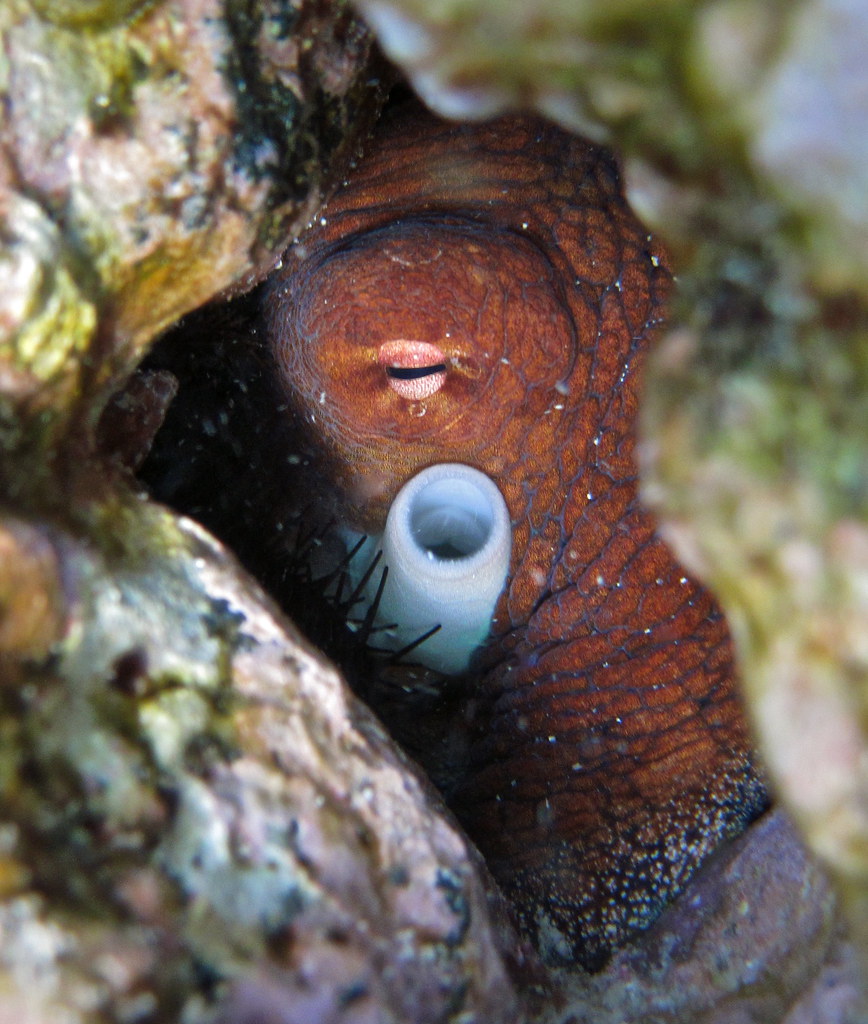
In the shallow waters of the Indo-Pacific, a spectacle unfolds that defies our conventional understanding of rest. The octopus, a creature with a distributed brain and a nervous system woven through its arms, undergoes rapid color changes during deep stillness. Its skin pulses with crimson, shifts to a mottled grey, and suddenly contracts into a bumpy, mossy green. This process is known as active sleep, and researchers believe it is the cephalopod equivalent of our REM stage. Yet, the central mystery remains: what do these creatures actually see when their bodies undergo such dramatic transformations in the dark? For decades, biologists assumed octopuses were colorblind because they possess only one type of light-sensitive protein in their eyes. However, their ability to blend perfectly with the chromatic nuances of a coral reef suggests a sophisticated perception of the spectrum. One leading theory suggests octopuses use chromatic aberration, where their wide, U-shaped pupils catch light at different angles to create color through focus. If this is true, color is not just a visual inhabitant of the world for an octopus, but a structural component of its reality. Their dreams might therefore be more vivid and technically complex than anything the human mind can construct. The natural world is full of instances where visual magnetism dictates behavior, such as the [bowerbird blue aesthetics](/article/nature-bowerbird-blue-aesthetics) where a single hue governs social success and evolutionary fitness. In the octopus, the link is more visceral, a biosensory feedback loop tied directly to survival and expression. The pigment cells, or chromatophores, are controlled by the nervous system, meaning every flash of color during sleep is an involuntary reflection of neural firing. If an octopus dreams of a predator or a hunt, its skin betrays the narrative before the animal even wakes. It is as if our own dreams were projected onto our skin for the world to see. This phenomenon forces us to reconsider how various organisms perceive the materials and surfaces of the world around them. While we look toward how [mycelium packaging replaces plastic](/article/tech-mycelium-packaging-replaces-plastic) as a way to harmonize technology with biology, the octopus has already mastered the art of organic transformation. In active sleep, it isn't just the pigment that moves; the very texture of the skin shifts, forming bumps called papillae to mimic rock or algae. This haptic and visual simulation is so convincing that a sleeping octopus essentially becomes its dreamed environment, a camouflage of the subconscious. The complexity of the octopus nervous system is staggering, considering two-thirds of their neurons reside in their arms. Each arm has a mind of its own, capable of tasting, feeling, and reacting independently of the central brain. Sleep, then, may not be a centralized event in the cranium but a collective state of the entire being. When an octopus dreams in colors it theoretically cannot see, it may not be experiencing color as a visual label, but as a series of frequencies or moods that the body naturally reproduces. This decentralized intelligence creates a dreamscape that is almost impossible for a human to imagine. Detailed studies in laboratories from Brazil to Japan have shown that the active sleep cycle lasts only a few minutes and repeats at regular intervals. During these short bursts, the octopus's skin is in constant motion, dancing to the rhythm of invisible visions. If their understanding of color is based on the physical refraction of light through specific focal shifts, then their dream world is built on pure geometry and optics. It is a reminder that consciousness is not limited to the human experience and that the ocean hides forms of intelligence that do not require our vocabulary or our specific visual receptors to thrive. Beneath the surface, a silent, colorful film plays out, with the sleeping cephalopod as both the projector and the screen.


The best evidence is behavioural and physiological. In 2021, researchers including Sidarta Ribeiro at the Federal University of Rio Grande do Norte reported quiet and active sleep states in Octopus insularis, with active bouts often lasting less than 1 minute and recurring roughly every 30 to 40 minutes. A 2023 study in Nature by Okinawa Institute of Science and Technology and University of Washington researchers found REM-like neural signatures in cuttlefish and octopus relatives. The mechanism is skin control: chromatophore organs expand or contract under motor-neuron control, while papillae change texture. Because many octopuses have only one visual pigment, the colour question remains unresolved. The limit is interpretation; a flashing mantle may reflect memory replay, motor practice or internal brain-state cycling, not a film-like dream.