A light-powered chip points to faster computing, but not without the electronics around it
Integrated photonic chips use photons in nanoscale waveguides to move and process information for AI and quantum experiments. The promise depends on fabrication, packaging and hybrid control.
Mira Vale ·
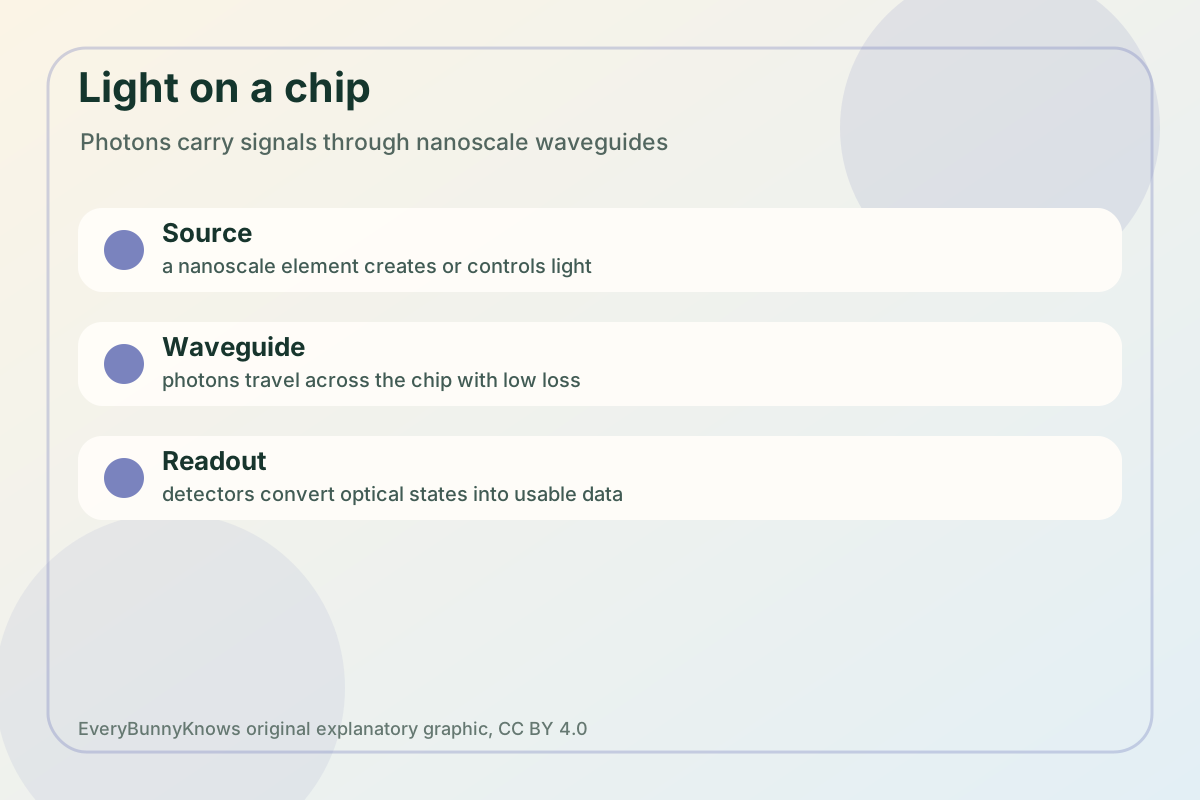
A light-powered chip for AI and quantum computing should not be imagined as a solar panel that runs a laptop. The more precise story is integrated photonics: a chip that creates, guides, changes and reads light inside nanoscale structures. ScienceDaily described a tiny photonic device using atomically thin materials and nanostructures to handle light-based information in one platform. If such devices mature, photons could help move data and perform certain operations with less heat and higher bandwidth than purely electronic wiring.
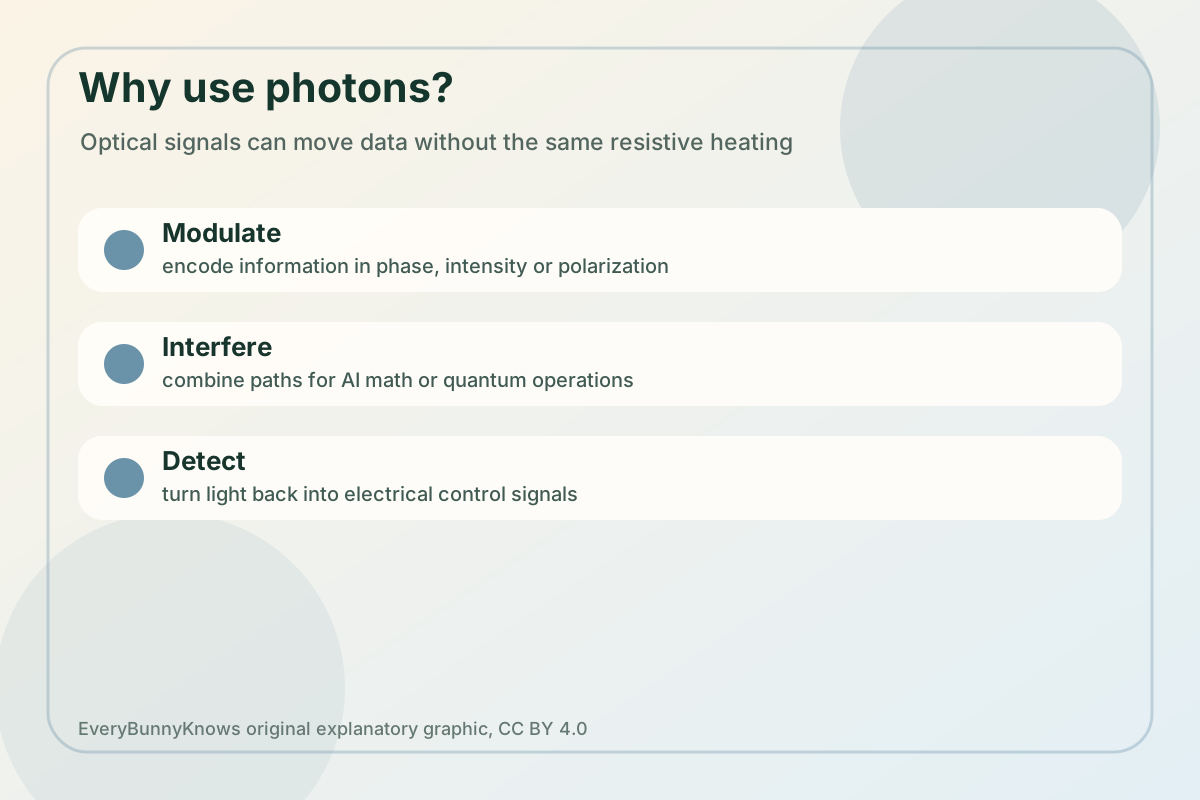
The mechanism starts with a waveguide, a microscopic path that confines light and routes it across a chip. Information can be encoded in intensity, phase, wavelength, timing or polarization. Modulators change those properties. Resonators and interferometers combine beams so that the output represents a calculation or quantum state. Detectors convert the optical result back into electronic signals that ordinary control systems can store and act on. Atomically thin materials are attractive because their optical and electrical properties can be strong even in layers only a few atoms thick.
For AI hardware, the appeal is data movement and matrix-like operations. Modern accelerators spend a large share of energy moving numbers between memory, processors and networks. Optical links already carry internet traffic over fibres; photonic chips try to bring some of that low-loss, high-bandwidth behaviour closer to the processor. Some research systems use interference to perform linear algebra, the mathematical core of many neural networks. The gain is not automatic: lasers, modulators, detectors, memory and calibration all consume energy too.
For quantum computing, photons have a different advantage. They interact weakly with the environment, which helps them carry quantum information through fibres and chips. Integrated photonic circuits can prepare paths, split beams, shift phases and measure single photons on a compact platform. That makes them useful for quantum communication, sensing and some computing architectures. The challenge is that useful quantum hardware needs reliable single-photon sources, low-loss circuits, fast switches, efficient detectors and error handling, not only an elegant waveguide.
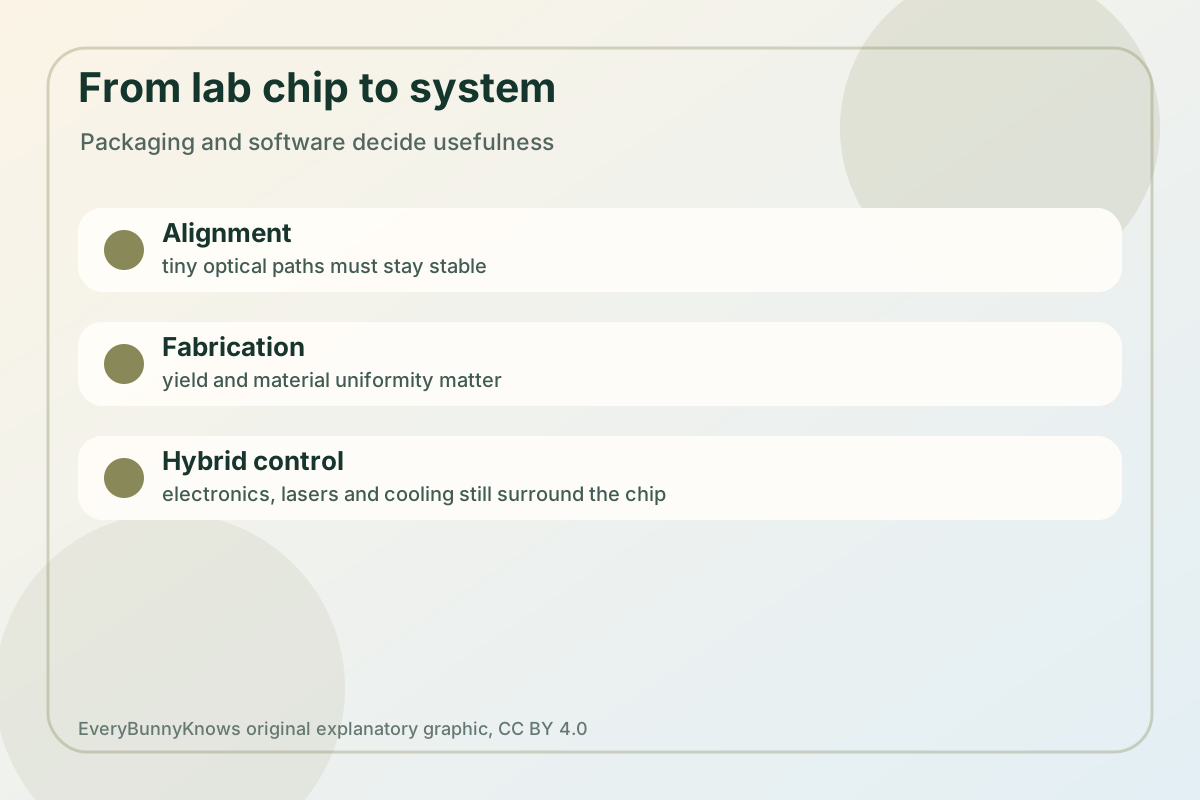
Maturity is therefore laboratory-to-prototype. Silicon photonics is commercially real in data communications, but AI photonic accelerators and quantum photonic processors remain specialized and demanding. Nanometre-scale roughness can scatter light. Temperature changes shift resonances. Coupling light from a fibre or laser into a chip is a packaging problem as much as a physics problem. Atomically thin materials must be placed uniformly, contacted electrically and protected from contamination if they are to leave a clean-room demonstration.
A useful evaluation will compare complete systems, not isolated optical paths. If a photonic accelerator saves energy in one multiply operation but spends it on laser power, thermal tuning or data conversion, the net result may be modest. If it reduces a communication bottleneck in a real workload, the benefit can be meaningful even without replacing the whole processor.
The hopeful point is bounded. Light can carry enormous amounts of information and can do some computations in ways that avoid the resistive heating of metal wires. A well-designed photonic chip might speed specific AI workloads, reduce communication bottlenecks or make quantum optical experiments more compact. It will not make electronics disappear. The useful future is hybrid: photons doing what light does best, electronics providing memory and control, and engineers proving that the combined system is faster, stable and manufacturable outside the lab.