Tiny Vibrating Beams Reframe the Memory Problem in AI Hardware
Cornell’s FeMEMS prototype stores analog values in a ferroelectric layer and reads them through beam motion, a lab route toward memory and computation living closer together.
Klára Novák ·
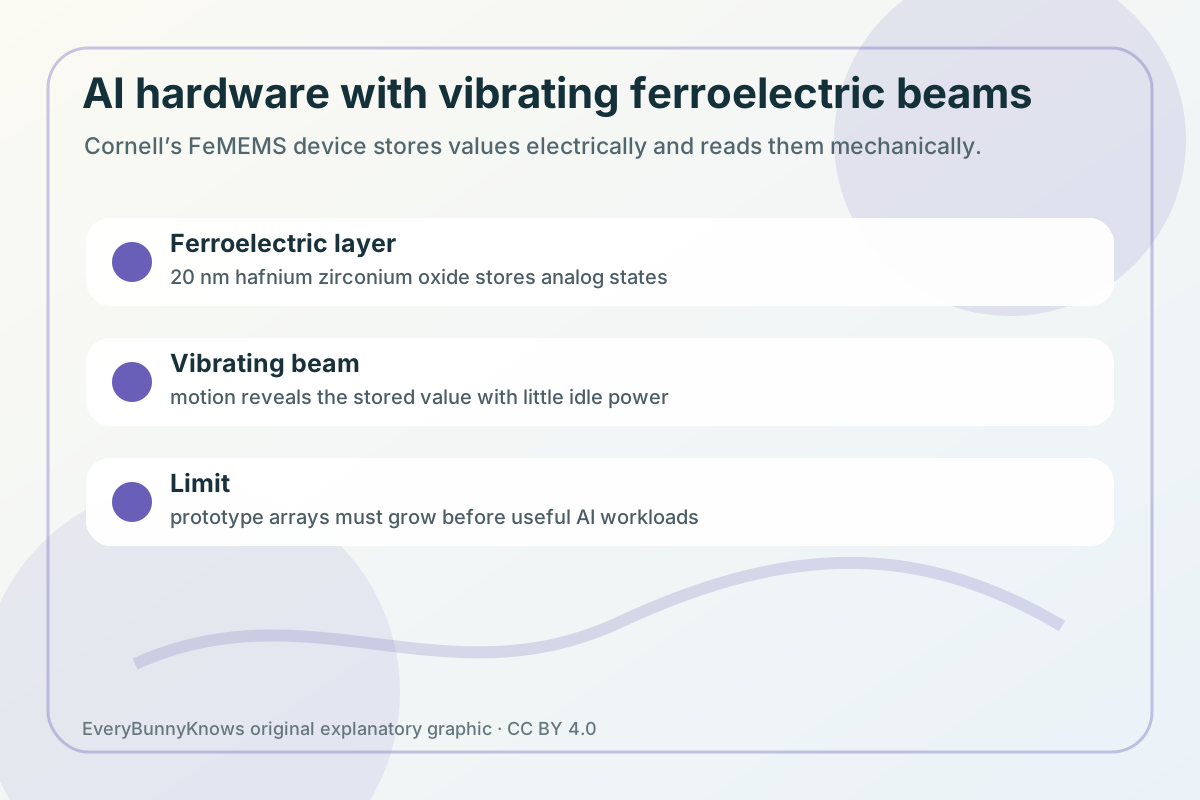
Modern AI hardware spends much of its effort moving numbers between memory and processors. Cornell's vibrating-beam device tackles that old bottleneck at the scale of materials. Researchers led by doctoral student Shubham Jadhav and electrical and computer engineering professor Amit Lal built a ferroelectric microelectromechanical system, or FeMEMS, that stores information electrically but reads it through mechanical motion. Cornell described the work in June 2026 after publication in Nano Letters.
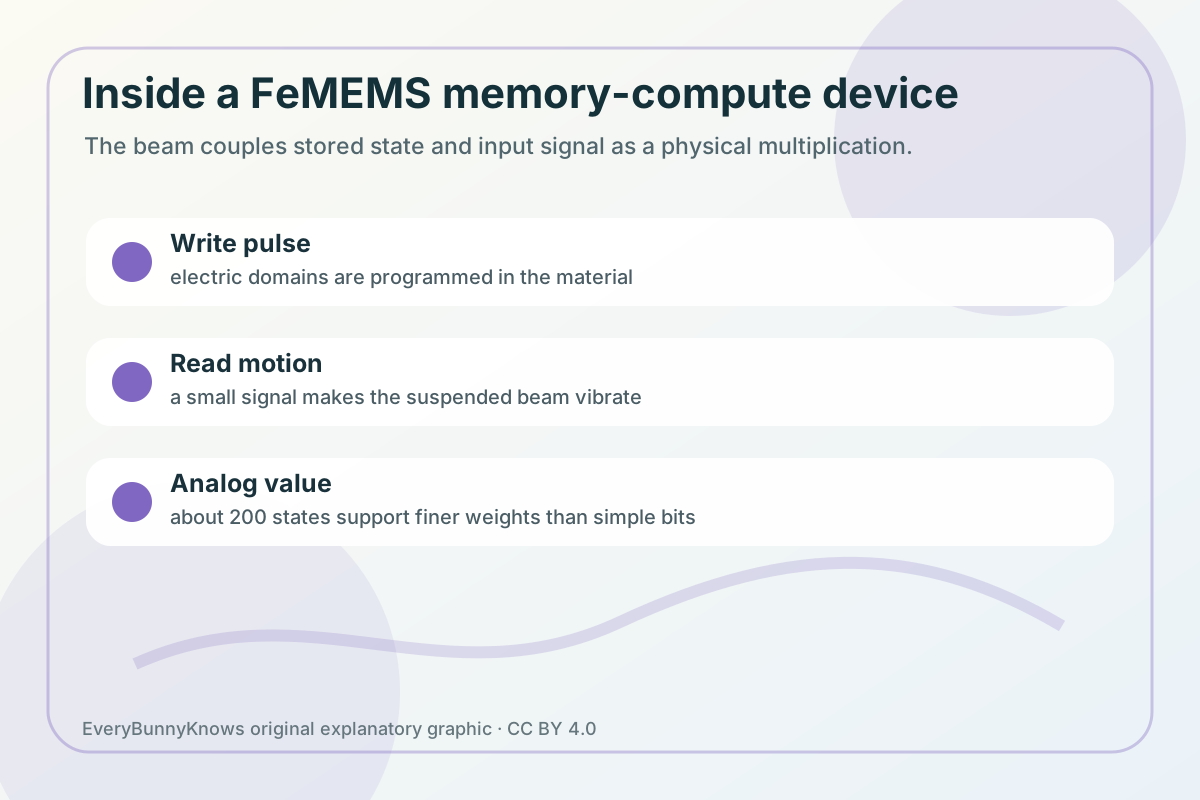
The mechanism starts with ferroelectricity. Certain materials keep an internal electric polarization after a programming pulse, rather like a tiny built-in memory of how their domains are oriented. The Cornell device uses a 20-nanometre layer of hafnium zirconium oxide integrated into a suspended microscopic beam. Electrical pulses write values by changing the orientation of ferroelectric domains. A small read signal then makes the beam vibrate, and the motion reveals the stored value without depending only on the same electrical path used to write it.
That separation matters because many experimental ferroelectric memory devices suffer from unwanted current paths or readout disturbances. By moving readout into a mechanical channel, the team is testing whether stored values can be accessed with lower idle power and less electrical interference at the device level. The result is not a simple one-or-zero switch. Cornell reported roughly 200 distinguishable electromechanical states, which is important for analog computing because small errors in stored weights can accumulate when many operations are combined.
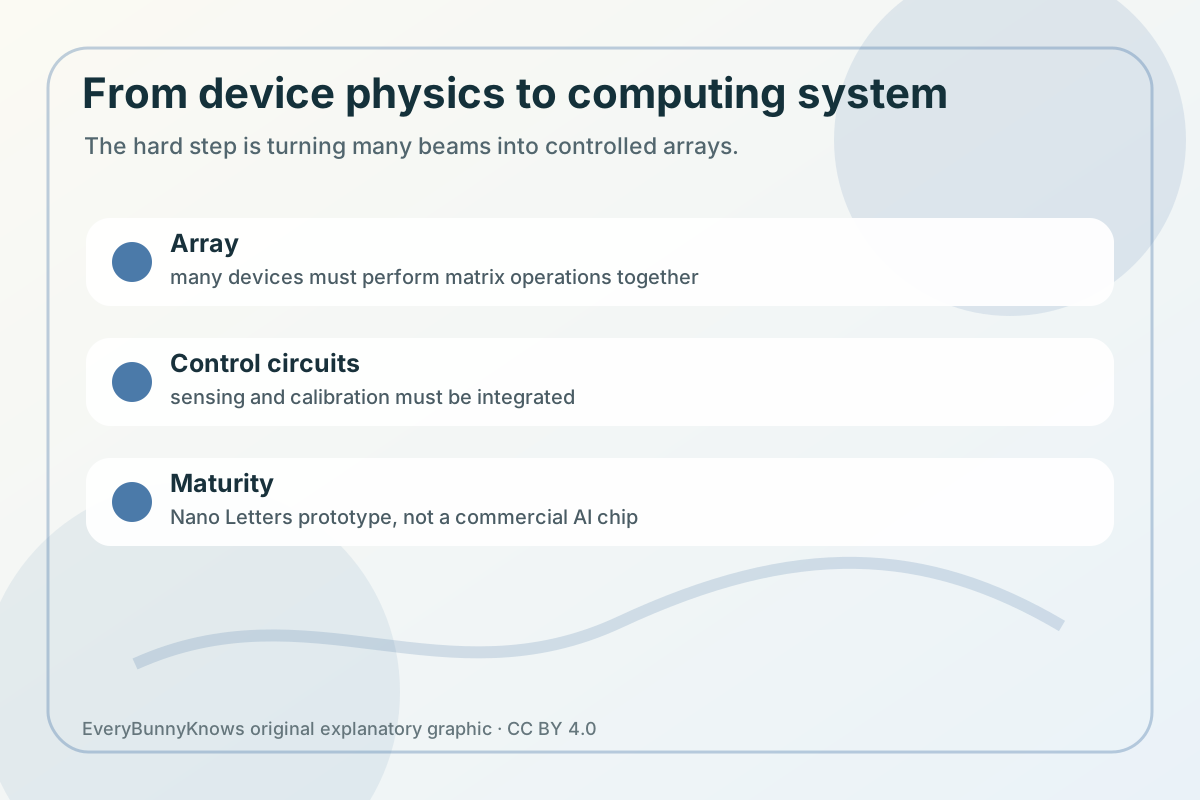
The computing idea is multiply-and-accumulate, one of the repeated operations behind neural networks and scientific simulations. In a simplified explanation from Cornell, the programmed beam state can stand for one number, the incoming signal for another, and the beam's motion for their product. If many such devices can be arranged into arrays, memory and computation could sit closer together, reducing some of the energy spent shuttling data back and forth.
The maturity is clearly laboratory. The phrase AI hardware can invite a picture of a chip ready for data centres, but this is a device and array-prototype result. The next step is larger arrays capable of more complex matrix operations, plus integrated control circuitry and capacitive sensing. Engineers would also need to prove endurance, temperature behaviour, variability between devices, manufacturing yield, calibration routines and compatibility with the rest of a computing stack.
The work is useful partly because it is honest about physics. CMOS chips are dominant because they are reliable, scalable and supported by decades of manufacturing. A vibrating ferroelectric beam will not displace that by being clever in one measurement. Its value is to reopen a design space with modern materials and microfabrication: maybe some future computing tasks can be served by devices where a material stores a value, a structure moves, and the motion itself helps compute.
There is also a systems question beyond the device. AI accelerators need memory hierarchy, data converters, error correction, packaging, heat removal and software that knows the hardware's strengths. Analog elements can save energy only if the surrounding circuitry does not consume the savings while measuring and correcting them. That is why the Cornell result is best read as a careful building block: a way to test whether ferroelectric state and mechanical motion can represent useful numbers before anyone claims a complete computing platform. That is a bounded but meaningful kind of progress.