A Newly Exposed Road at Side Shows How an Ancient Port City Worked
Excavations at Side on Turkey’s Mediterranean coast have exposed a road leading into the ancient city, a practical clue to how theaters, temples, baths, fountains and harbor life connected.
Noah Circuit ·
A newly exposed road at Side is the kind of archaeological discovery that sounds modest until you imagine using it. The ancient city, on Turkey’s Mediterranean coast in Antalya Province, is famous for its theater, temples of Athena and Apollo, baths, agoras, monumental fountain, gates and harbor setting. A road leading into that urban world is not just a line of stone. It is evidence for how people approached monuments, moved goods, drained water, repaired surfaces and made a port city function.
The short news item behind the slug reports excavations on the southern coast of Anatolia that uncovered a road or street leading to ancient Side. That is enough to justify a careful, concrete question: what can a road teach that a temple façade cannot? Roads preserve the ordinary choreography of a city. They point toward gates and gathering places. Their width, paving, edges and drains can show whether a route served pedestrians, carts, processions, market traffic or later repairs. Even when the first report gives few dimensions, the category of evidence is powerful.
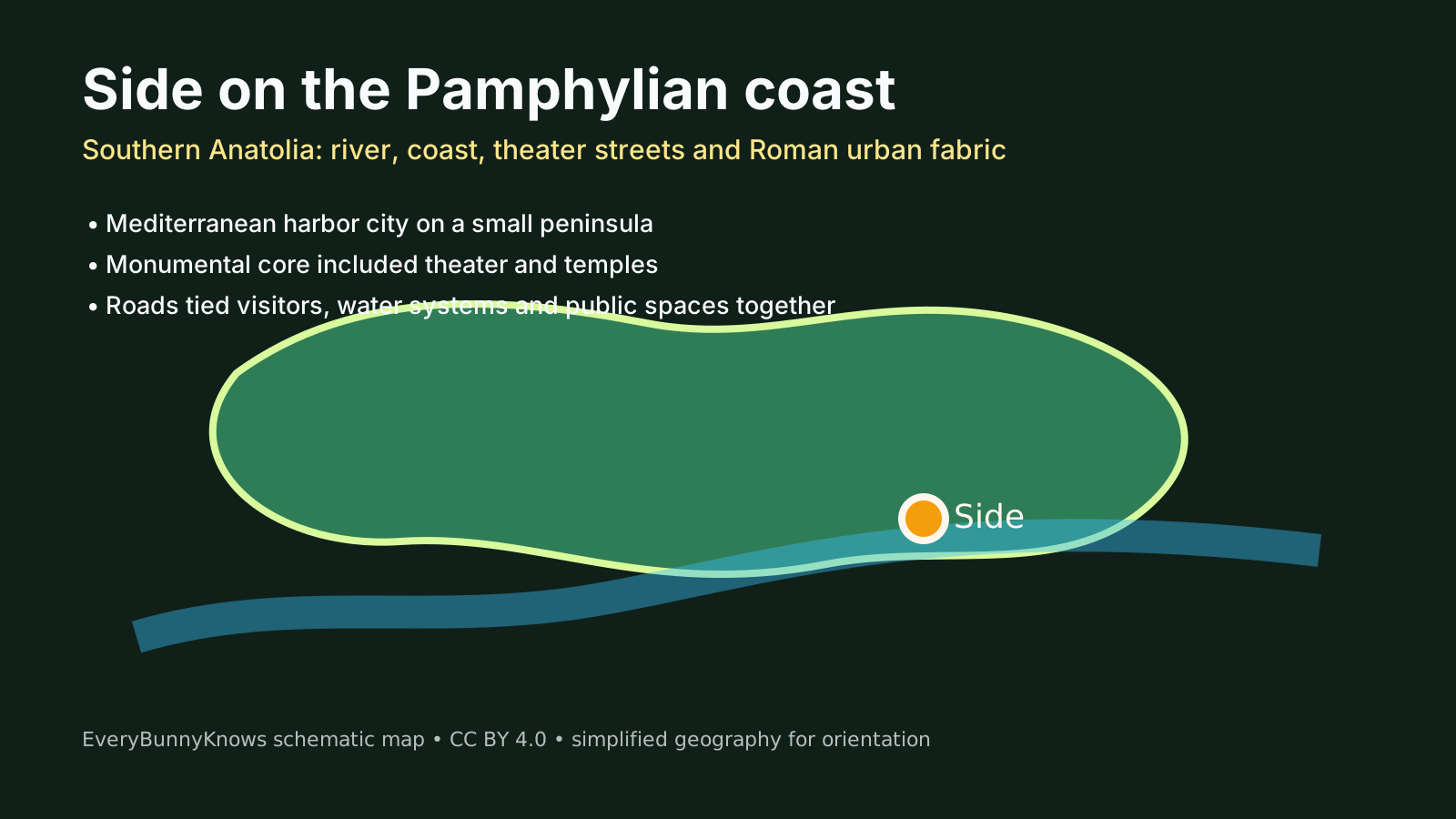
Side’s geography gives the find extra weight. The city grew on a small peninsula in Pamphylia, a region where Anatolian, Greek, Roman and later Byzantine histories overlapped. A harbor city needed more than beautiful buildings. It needed routes from water to market, from gate to theater, from baths to houses, and from public fountains to the spaces where people worked. The road is a reminder that urban life is a system. Monuments are the visible peaks; streets are the connective tissue.
The mechanism is movement. If a temple tells us about worship and a theater about performance, a street tells us about sequence. A visitor entered, turned, paused, joined a crowd, avoided mud, followed shade, met vendors or crossed service zones. Archaeologists can compare a newly cleared road with city walls, public buildings, water systems and known excavation areas. That comparison may reveal whether the route was planned with the monumental core, adjusted after damage, narrowed by later construction or reused in a different period.
Side is especially readable because its remains include several kinds of public architecture. The theater speaks to crowd life. The temples near the shore tie civic identity to the sea-facing skyline. Baths and fountains make water management visible. The agora and necropolis place commerce and memory within the same urban landscape. A road linking or approaching these spaces helps scholars and visitors stop treating them as isolated postcard views. It turns ruins back into a walkable city.
There are limits. Without a full excavation report, it would be wrong to assign a precise date, length or traffic pattern beyond what the published notice supports. Roads can also be repaired many times, so one surface may not represent one historical moment. The responsible conclusion is therefore not that Side’s whole history has been solved. It is that infrastructure is a valuable archive. Each newly cleaned stretch can sharpen maps, guide conservation, protect fragile remains and help visitors understand why ancient cities were lived networks rather than collections of monuments.
The hopeful lesson is quiet. Archaeology often advances by exposing exactly this kind of practical feature. A road does not need a dramatic inscription to matter. At Side, it can reconnect a famous coastal site with the feet, wheels, water and maintenance that once made the city work.