Stanford’s twisted-light device is a quantum interface, not a room-temperature quantum computer yet
A Stanford team coupled a silicon chiroptical cavity with atomically thin MoSe2 to produce valley-selective emission at room temperature. The result is promising for quantum communication hardware, but it is still a nanoscale device, not a deployable quantum computer.
Noah Circuit ·
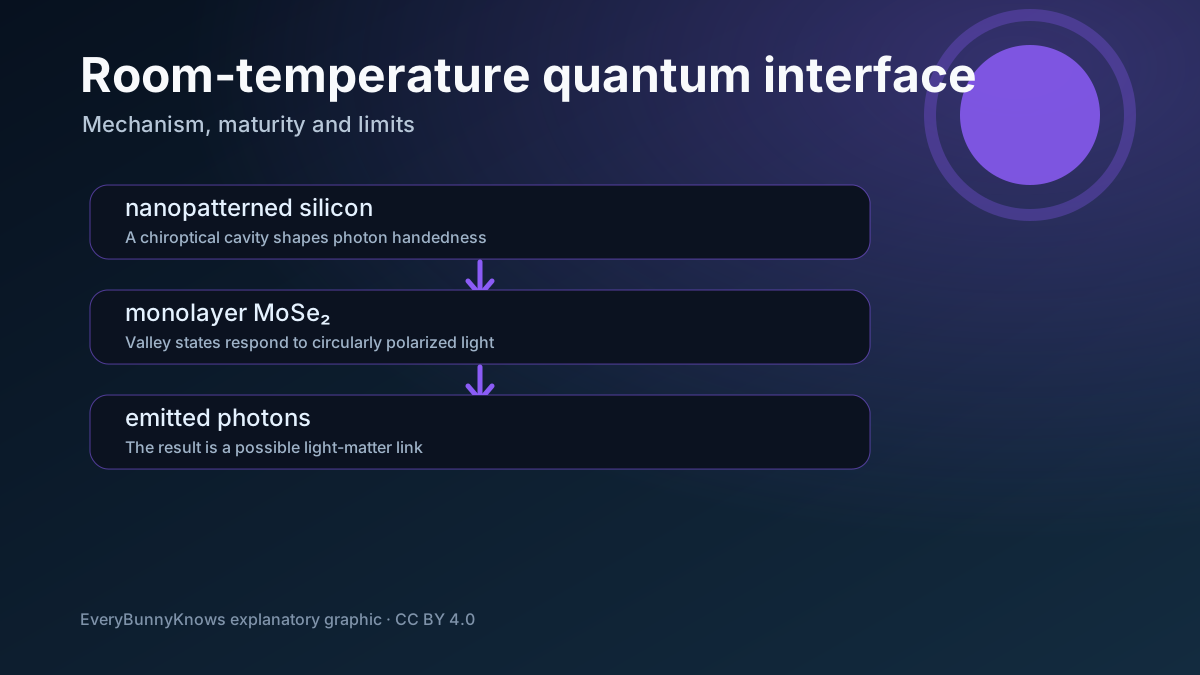
Stanford researchers have demonstrated a room-temperature light-matter device that sounds dramatic only if the words are read too quickly. It is not a finished quantum computer. It is a nanoscale quantum interface: a patterned silicon structure coupled to a thin layer of molybdenum diselenide, or MoSe2, that can make emitted light favor one quantum “valley” state over another. The result, reported in Nature Communications as room-temperature valley-selective emission in Si–MoSe2 heterostructures enabled by high-quality-factor chiroptical cavities, is a useful step for quantum photonics.

The mechanism begins with twisted light. Photons can carry circular polarization, often described as left- or right-handed. In certain atomically thin semiconductors, electrons can occupy different valley states, which are not valleys in space but energy landscapes inside the material’s band structure. If a device can make one handedness of light couple preferentially to one valley, it gains a way to link optical signals with electronic quantum states.
The Stanford design uses a nanopatterned silicon substrate as a chiroptical cavity. “Chiral” here means that the structure distinguishes handedness. The patterned features are around the scale of visible wavelengths, so they shape light in a way the eye cannot see directly. MoSe2, a transition-metal dichalcogenide, sits in that optical environment. Together they support valley-selective emission at room temperature, a feature that matters because many quantum systems need cryogenic cooling to keep fragile states from being washed out.
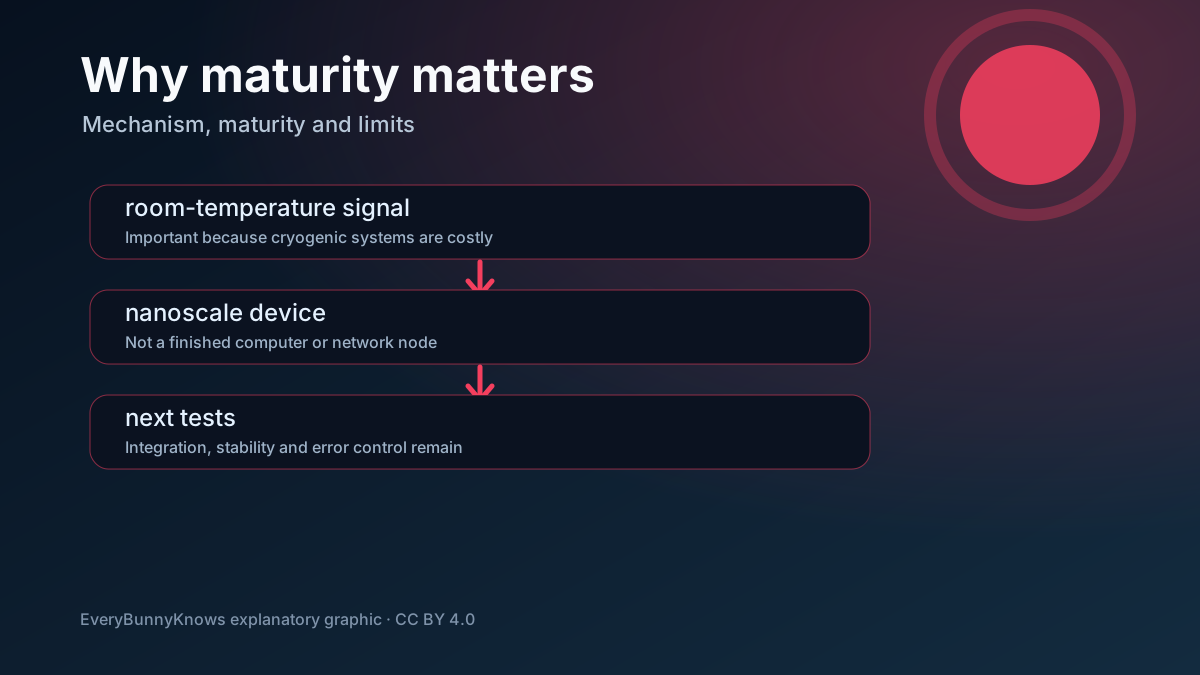
That room-temperature point is the reason the story deserves attention. Cooling quantum hardware near absolute zero is expensive, bulky and energy-intensive. A stable optical interface that works without extreme refrigeration could eventually simplify parts of quantum communication, sensing or computing hardware. It also fits a wider movement in nanophotonics: using carefully patterned materials to perform optical tasks that once required larger lenses, filters or cavities.
The limits keep the result honest. Valley-selective emission is not the same as reliable qubits, error correction, memory, routing, manufacturing yield or a programmable processor. The device must be integrated with sources, detectors, control electronics and packaging before it becomes a technology platform. Researchers also need to test stability, reproducibility and performance across many devices, not just a carefully fabricated sample.
The language also needs care because “room temperature” can be misleading. It removes one difficult requirement from this part of the optical interface; it does not remove noise, fabrication tolerances or the need to protect quantum information. The result is best understood as a component-level advance inside a much larger machine.
That distinction is useful for readers because quantum headlines often compress several technologies into one promise. Quantum communication needs interfaces that can create, carry and read fragile states; quantum computing also needs gates, memories and correction of errors that accumulate quickly. A room-temperature optical emitter may help one piece of that stack without making the rest automatic.
So the hopeful reading is narrow and interesting. Stanford’s work suggests that light’s handedness and a two-dimensional semiconductor can exchange quantum information under gentler conditions than many people associate with the field. If future devices can preserve that selectivity while being manufactured and connected at scale, twisted-light interfaces may become one of the quieter parts that make quantum networks less exotic and more buildable.